

If you run a business in Kenya today, you’ve probably noticed one thing, your customers are online. Whether you sell food, fashion, or services, most people will search Google before they ever call or visit. That’s where SEO (Search Engine Optimization) and Google My Business (GMB) come in.
SEO and Google My Business are not just digital words; they’re real tools that can help you increase visibility, attract customers nearby, and grow your local sales dramatically. We all love convenience. We search for ‘restaurants near me,’ ‘best tailor in Nairobi,’ or ‘affordable web hosting in Kenya.” If your business doesn’t show up in those searches, you’re losing potential customers every day.
What is Local SEO?

Local SEO is the process of optimizing your online presence so your business appears in search results when people nearby look for products or services like yours. For example, if someone in Nairobi searches for “best cake shop near me,” Google automatically shows bakeries within that area. That’s local SEO in action.
Unlike general SEO, which targets a global or national audience, local SEO focuses on a specific geographical area. It’s about connecting you with customers who are physically close to you and ready to buy.
In Kenya, where most customers shop within their cities or neighborhoods, local SEO can transform small businesses into local champions. It helps you appear on Google Maps, in the “local pack” (the top 3 businesses shown on Google), and even in voice searches.
When done right, local SEO ensures your business doesn’t just exist online, it gets found by people who matter most that is local customers ready to make a purchase.
How Kenyan Consumers Search Online
To understand how to use SEO effectively, you first need to understand how Kenyans search. Kenya is a mobile-first nation, where a large percentage of internet users access the web through smartphones. That means your potential customers are constantly using Google to find products and services while on the move.
Common search patterns include:
- “Where to buy…”
- “Best [product/service] near me”
- “Affordable [product/service] in [city name]”
Google’s algorithm uses location data to show nearby businesses that match the search. So if your GMB profile isn’t optimized or your website doesn’t include location keywords, you’ll miss out on those high-intent customers. Additionally, Kenyans tend to trust reviews and visual content. A well-optimized business with photos, reviews, and accurate contact info stands out immediately.
Understanding this behavior is key to tailoring your SEO and GMB strategies to match how Kenyans actually search, fast, local, and visual.
Benefits of SEO for Local Businesses
Implementing SEO is one of the smartest moves any Kenyan business can make. Here’s why:
| Benefit | Description |
| Increased Visibility | Your business appears when people search for your services in your area. |
| Credibility and Trust | High-ranking websites and verified GMB profiles make your business look more professional. |
| Targeted Traffic | You attract people who are actively looking for what you offer. |
| Cost-Effective Marketing | Unlike paid ads, SEO brings long-term, organic traffic. |
| Competitive Advantage | You can outrank bigger brands by focusing on local keywords and authentic engagement. |
Simply put, SEO levels the playing field. Even a small business with limited resources can dominate search results in its area by focusing on local optimization.
With telaHosting’s SEO-friendly hosting solutions, your website loads faster, stays secure, and performs better with all crucial ranking factors that make Google trust your site.
How to Use SEO on Your Website for Local Sales
Your Google My Business profile is just one part of the local SEO puzzle. To truly dominate local searches, your website must also be optimized for visibility and conversion. If your website is hosted with us at telaHosting, you already have an advantage: fast loading speeds, reliable uptime, and SEO-friendly infrastructure that helps you rank higher on Google.
Here’s how to use SEO to attract more local customers:
1. Optimize for Location-Based Keywords
Keywords are the backbone of SEO. They’re the words people type into Google when they’re searching for something. For local SEO, you want to use location-specific keywords, ones that include your city, town, or county.
Here’s a quick example of how you can use them:
| Business Type | Generic Keyword | Local Keyword (Better for SEO) |
| Fashion store | best clothing store | best clothing store in Nairobi |
| Restaurant | family restaurant | family restaurant in Westlands |
| Salon | natural hair stylist | natural hair stylist in Mombasa |
| Real estate agent | property agent | property agent in Kisumu |
By including your city or region in your keywords, you signal to Google that your business is locally relevant. Include these keywords naturally in your:
- Page titles
- Meta descriptions
- Headers (H1, H2)
- Blog posts
- Image alt text
2. Create Locally Relevant Content
Content is king, but relevant content is the king of kings especially for local SEO. If you want to attract Kenyan customers, create blog posts or web pages that speak directly to your local audience’s needs and experiences. Here are examples of content ideas that boost local sales:
- “Top 10 Wedding Photographers in Nairobi You Should Know”
- “How to Find Reliable Tailors in Nakuru”
- “Best Food Delivery Services in Mombasa”
- “Where to Buy Affordable Laptops in Nairobi CBD”
This kind of content doesn’t just inform, it connects. Kenyans value relatable, practical information, so don’t be afraid to write in a friendly, conversational tone. Mention real neighborhoods, towns, and local experiences where appropriate.
When locals find your content relatable, they’re more likely to trust your brand and buy from you.
3. Optimize for Mobile
In Kenya, more than 80% of internet users browse using their mobile phones. That means if your website isn’t mobile-friendly, you’re losing potential customers every single day. A mobile-optimized website should:
- Load in under 3 seconds
- Display clearly on small screens
- Have clickable buttons and easy navigation
- Include click-to-call options for quick inquiries
Google ranks mobile-friendly websites higher because it knows people prefer fast, easy-to-use pages.
4. Add Schema Markup
Schema markup (also called structured data) is a piece of code that helps Google better understand your website’s content. For local businesses, you can use schema to tell Google:
- Your business name
- Your address and phone number
- Your operating hours
- Customer reviews
- Product or service details
This data increases your chances of appearing in rich results, those attractive listings that show ratings, images, and business details directly on the search results page.
5. Get Local Backlinks
Backlinks are when other websites link to yours. They’re like votes of confidence that tell Google your business is trustworthy. For local SEO in Kenya, focus on local backlinks from:
- Kenyan blogs and media outlets
- Local business directories
- Chambers of commerce or trade associations
- Influencer mentions or collaborations
Example: If your restaurant is featured in an article on Nation Africa or Pulse Kenya, that backlink can significantly boost your ranking in local searches. You can also partner with nearby businesses, for example, a fashion store can collaborate with a local makeup artist for a “Style & Glam” blog feature where both websites link to each other.
6. Build Strong Internal Links
Internal links are the links that connect different pages on your website. They help Google understand your site’s structure and keep visitors browsing longer. For example, if you own a bakery in Westlands, you might write a blog titled “Best Cakes for Kenyan Weddings”. Inside that blog, link to your “Wedding Cakes” product page.
This does two things:
- Helps customers easily navigate your website.
- Boosts the SEO strength of your linked pages.
Use descriptive anchor text, instead of “click here,” use something meaningful like “order custom wedding cakes in Nairobi.”
.
What is Google My Business (GMB)?

Google My Business is a free tool from Google that lets you manage how your business appears in search results and on Google Maps. It includes your business name, location, operating hours, contact info, reviews, and even photos.
How to Set Up Your Google My Business Profile
Creating your GMB profile is simple but must be done correctly to see real results. Follow these steps:
Step 1: Go to Google My Business and sign in with your Google account.
Step 2: Enter your business name exactly as it appears offline.

Step 3: Choose your business type (e.g., “online retail” “local store,” “service business”).
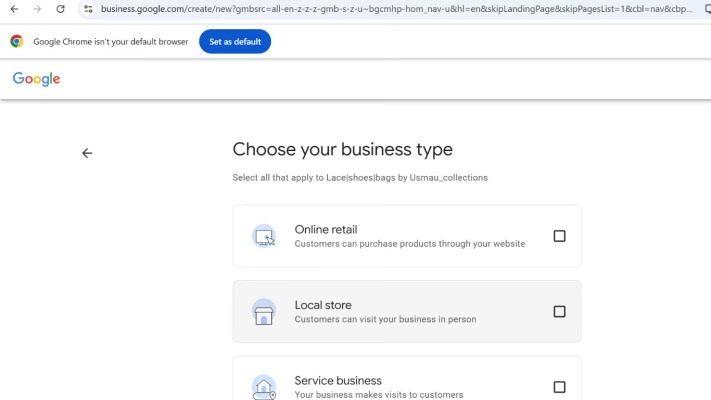
Step 4: Choose the correct category (e.g., “Fashion accessories” “Beauty store,” “Family Counselor”).

Step 5: Add your physical address, phone number, and operating hours.
Step 6: Verify your business (usually via postcard, email, or phone).
Step 7: Upload high-quality photos of your location, products, and team.
Step 8: Write a clear, keyword-rich business description.
Tip: Use local keywords in your business description like “affordable event planner in Nairobi” or “trusted mechanic in Surulere.”
Once verified, your business can start appearing in Google Maps and search results when people in your area search for related services.
How to Optimize Your GMB Profile to Drive Local Sales
Now that your Google My Business profile is live, it’s time to make it shine. A complete, optimized profile gives you an edge over competitors and helps Google understand your business better. When someone searches for your service in your area, Google decides which businesses to show based on relevance, distance, and prominence. Your goal is to boost all three, and optimization is how you do it.
Here’s how to optimize effectively:
1. Use the Right Keywords: Include relevant keywords naturally in your business description, posts, and even the Q&A section. For example, instead of saying “We are a cleaning company,” you can say: “We are a professional cleaning company in Nairobi, offering affordable home and office cleaning services.”
This helps you appear in more local searches.
2. Add Quality Photos and Videos: Visuals attract attention. Kenyan customers like seeing proof such as photos of your shop, team, or products, as this makes your profile more trustworthy. According to Google, businesses with photos get 42% more requests for directions and 35% more website clicks.
3. Post Regularly: Use your GMB profile like a mini social media feed. Share updates, promotions, or new arrivals weekly. Google rewards active profiles with better visibility.
4. Encourage and Respond to Reviews: Reviews are a huge trust factor. Ask satisfied customers to leave honest reviews and always reply, even to negative ones. A polite response to a bad review shows professionalism and care.
5. Keep Information Consistent: Ensure your business name, address, and phone number match exactly on your website, social media, and GMB. Inconsistent information confuses Google and lowers your ranking.
6. Use Attributes and Categories: Choose accurate business categories and add attributes such as “wheelchair accessible,” “delivery available,” or “women-led business.” These details make your listing richer and more appealing.
7. Add Your Website and Social Media Links: Linking your website and social pages (Instagram, Facebook, X) to your GMB profile helps customers explore your brand more deeply. When users click your website link, make sure it loads quickly and looks professional, as this first impression can make or break a sale.
8. Enable Messaging and Click-to-Call Options: Kenyan customers value convenience. When they see your business on Google, they often want to reach you immediately. Turn on the “Message” feature in your GMB dashboard so customers can chat with you directly. You can also enable click-to-call, allowing mobile users to reach you with one tap. Quick responses convert browsers into buyers.
9. Use GMB Insights to Understand Your Customers: GMB offers a free tool called Insights, which shows how people find and interact with your business. You’ll see data such as:
- How many people searched for your business
- Whether they found you through Google Maps or Search
- Which keywords they used
- How many requested directions or clicked your phone number
By studying this data, you’ll know what’s working and where to improve. For example, if most people find you through Maps, you may want to focus more on location-based promotions.
When you optimize your GMB profile, you create a digital storefront that tells customers and Google that you’re active, trustworthy, and relevant.
Conclusion
In today’s digital world, success in business isn’t about who shouts the loudest, it’s about who gets found first. And in Kenya’s fast-growing digital economy, SEO and Google My Business are powerful tools for visibility, trust, and sustainable growth.
By mastering local SEO, optimizing your GMB profile, collecting genuine customer reviews, and using social media strategically, you can attract nearby customers with ease. When these efforts are combined with reliable, SEO-optimized web hosting, you create a solid foundation that supports long-term online success.
Remember, your next loyal customer in Kenya is already searching for your business on Google right now. Make sure they find you.
FAQs
1. How long does it take for SEO to show results in Kenya?
SEO is a gradual process. With consistent optimization of your website and Google My Business profile, you can start seeing noticeable results within 3 to 6 months.
2. Is Google My Business free to use?
Yes. Creating and managing a Google My Business profile is completely free and it remains one of the most effective tools for improving local visibility.
3. Can I manage Google My Business on my phone?
Absolutely. You can manage your profile using the Google Maps app or the Google Business Profile Manager to update details, post photos, and respond to reviews on the go.
4. How does telaHosting improve SEO performance?
telaHosting provides fast, secure, and mobile-optimized hosting, all of which are important ranking factors Google considers when positioning websites in search results.
5. What’s the best way to rank higher on Google in Kenya?
Focus on Kenyan local keywords, encourage positive customer reviews, and keep both your GMB profile and website consistently updated. Engagement and accuracy play a major role in ranking higher.